The great ad waste engine
Why your ad spend is being hyjacked by your own AdTech vendors.
By T.J. Muro
Published
Updated
For thirty years, digital advertising has operated on a foundational lie: that scale requires surveillance. We let ad networks pivot from pipes that deliver our creative into gatekeepers of our audiences. They traded relevance for volume, and traded our hard-won customer data for "Identity Graphs" that feed their own predictive models — at our expense.
I spent most of my career drinking the Kool-Aid. I believed the dashboards. I believed the Identity Graphs. I believed the platforms when they promised me my budget was being optimized for "human outcomes."
I was wrong. And if you're a marketer in 2026, you're likely being lied to, too.

You have felt this
You know the feeling. You deliver a "lead," and the sales team tells you it's garbage. Every vanity metric is hitting, and yet the business is not growing. Reports are green while pipeline is flat.
That is not a lack of optimization. That is the Arbitrage of Opacity — the gap between what your vendor claims to do and what they can actually prove.
The primitive line of code that broke a
trillion-dollar market
The industry built a trillion-dollar engine on the back of a corrupting artifact from the dial-up era: the cookie. It tracks everyone, targets everyone, and connects with almost nobody. It took the creative, human spirit of advertising and turned it into an automated bot farm — while gaslighting you into believing that this lack of transparency is "privacy."
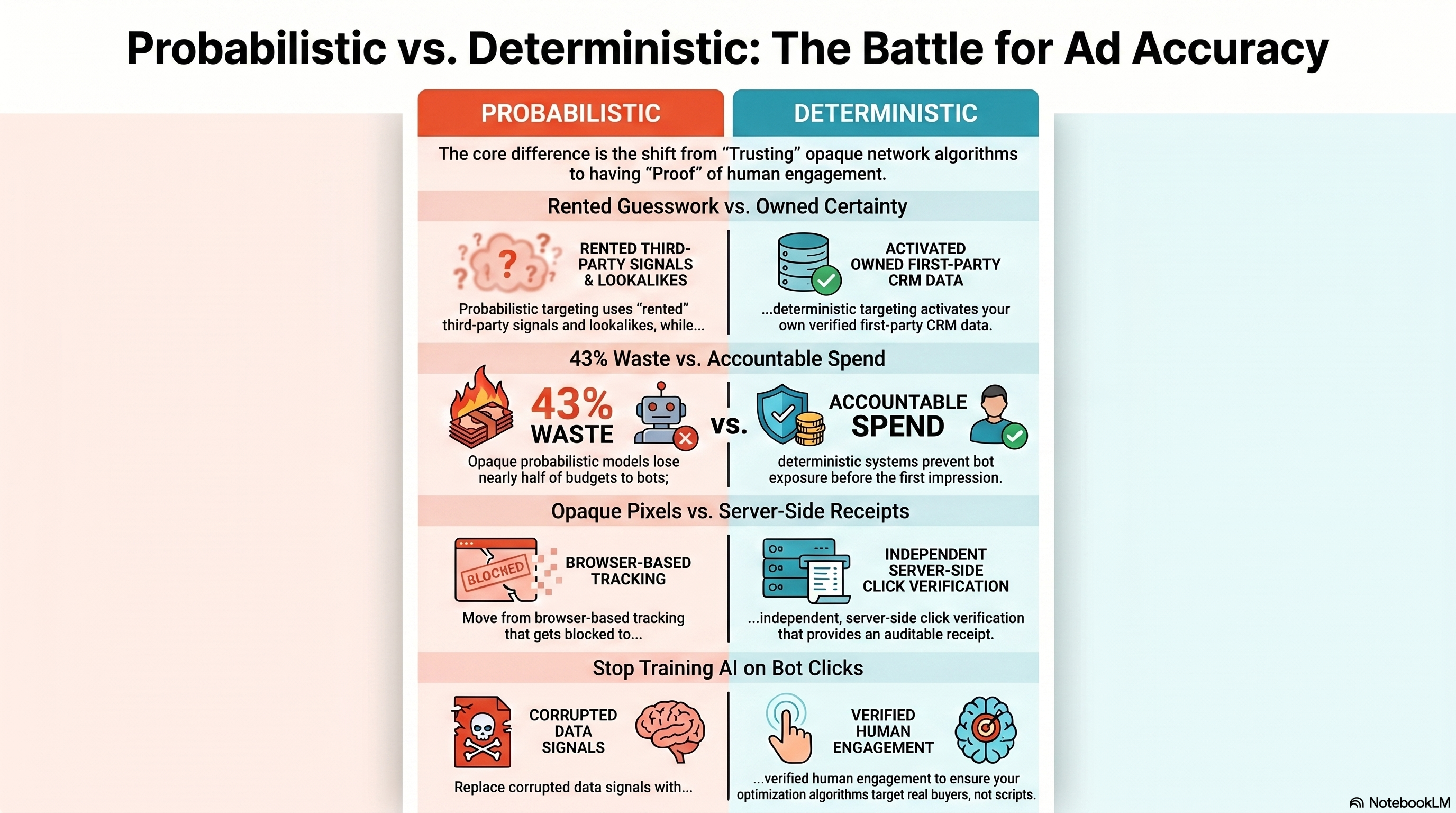
The Lookalike Trap
I'm done with the workarounds. I'm done with the "privacy-safe" laundering. I'm done with the Lookalike Trap — the practice of abandoning your real, qualified customers to chase probabilistic ghosts who don't exist. Ghosts don't renew. Ghosts don't refer. Ghosts don't buy.
We built an entire industry that penalizes marketers for owning their audience and rewards platforms for renting it back to them.
What we are building instead
HumanClicks is the Accountability Layer. Independent infrastructure that:
- Names every downstream partner touching your first-party data.
- Isolates your data instead of using it to enrich a shared model.
- Issues a verified receipt for every paid media transaction, so every dollar has proof behind it.
- Propagates hard-delete requests and returns documented proof the data is gone.
We don't treat your customers like data and your budget like an ATM.
Prove it — a test you can run today
Ask your current AdTech partner for a data deletion trail. Not a policy PDF. An actual trail. Where did the data go, who processed it, on what date, and how did they purge it. If they cannot show you that, they are not protecting your privacy. They are laundering your assets.
Download the workbook
We wrote the four interrogations down so you can bring them into your next QBR. This is the vendor test that will break the ones that deserve to be broken.
- The Provenance Question — who receives your first-party data.
- The Laundering Question — whether your data enriches their global model.
- The Verification Question — whether a human actually saw your creative.
- The Deletion Question — whether erasure propagates and comes back documented.
If a vendor refuses to answer any of the four, that is your answer.
FAQ
What is the "Arbitrage of Opacity"? The gap between what a platform reports and what they can actually prove. The bigger the gap, the more of your budget gets absorbed by intermediaries you cannot audit.
Why is a cookie the problem? The cookie was designed for a single-domain, single-session web. Everything since — cross-site tracking, identity resolution, lookalikes — is a workaround stacked on a workaround. Probabilistic guessing dressed up in "graph" language.
What replaces probabilistic targeting? Deterministic activation on verified, consented, first-party audiences, paired with a verification layer that produces receipts per transaction. Fewer impressions, more customers.
Is this an anti-platform position? No. It's an anti-opacity position. Platforms are welcome to participate — the ones that can answer the four questions on the record.