The 2026 state of ad waste
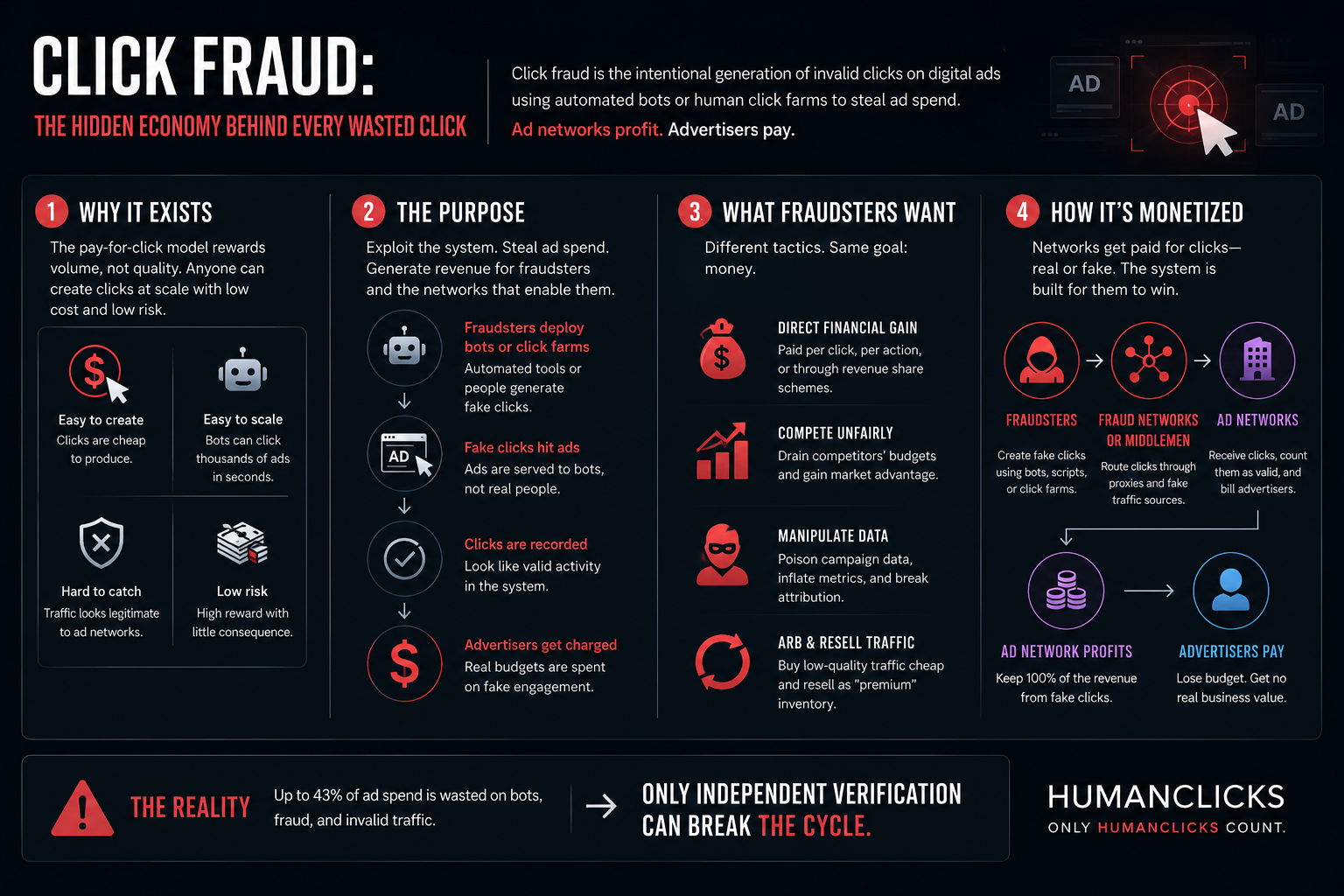
Identity, AI, and the accountability gap in a trillion-dollar media market. Up to 43% of ad spend is modeled waste exposure, with as much as 22% lost to invalid clicks.
By T.J. Muro
Published
Updated
Up to 43% of ad spend is waste, according to HumanClicks' two-year research synthesis: as much as 22% lost to bots, fraud, and invalid clicks; 18% to poor targeting, meaning real humans outside the eligible audience; and 3% to campaign inefficiency. This is an upper-bound benchmark, not a claim that every advertiser loses exactly 43%. Actual waste varies by channel, market, objective, buying method, controls, and advertiser. The question this report answers is: what can an advertiser prove about the media it paid for?
The 2026 State of Ad Waste: Identity, AI, and the accountability gap in a trillion-dollar media market. HumanClicks Premium Industry Report, August 2026. Author: T.J. Muro, HumanClicks.
Key findings
- Up to 43% of ad spend is modeled waste exposure (HumanClicks benchmark): as much as 22 points bots, fraud, and invalid clicks; 18 points poor targeting (human, but the wrong audience); 3 points campaign inefficiency. Invalid clicks account for nearly half of the modeled waste.
- $1.06T–$1.30T: 2026 global advertising forecasts from dentsu and WARC. The range reflects different market definitions.
- More than 22% of global digital ad spend, approximately $84 billion, was lost to ad fraud in 2023 (Juniper Research).
- 11.3% → 17.9%: CHEQ measured fake traffic rising year over year across 34 billion data points.
- 22% invalid-click rate for North American mobile-app traffic in Q1 2025 (Pixalate, across more than 43 billion open-programmatic transactions).
- 36¢: the share of a $1.00 entering a DSP that effectively reached the consumer in the ANA's 2023 open-web programmatic study. This covers several efficiency factors, not fraud alone.
- 75% of ad spend will be algorithmically enabled by 2028 (dentsu forecast).
- 66% of buyers planned greater focus on agentic AI buying or campaign execution (IAB 2026 Outlook Study).
- 36% of buyers want an AI-agent audit trail; 40% want humans in the loop (IAB 2026 digital-video research).
What is ad waste?
Ad waste is any paid media cost that fails the advertiser's documented eligibility, quality, delivery, audience, or outcome standard. That definition is intentionally broader than fraud and narrower than "did not convert." A human click that does not convert is not automatically waste, and a platform-attributed conversion is not automatically proof of incremental value.
The six-layer ad-waste model
- Transaction invalidity: the event should not have counted. This covers GIVT (bots, crawlers), SIVT (hijacked devices, click farms, spoofing), and duplicate or forced clicks.
- Delivery failure: non-viewable delivery, CTV playing to an off screen, broken destinations, or delivery outside agreed geography or placement rules.
- Supply-chain leakage: undisclosed intermediaries, duplicated supply paths, made-for-advertising inventory, and unreconcilable fees.
- Audience mismatch: a real person who is not an eligible one. Causes include weak modeled audiences, stale attributes, shared-device ambiguity, and unsuppressed customers.
- Measurement loss: missing signals, conflicting attribution windows, undisclosed modeled conversions, and unreconciled platform, CRM, and commerce totals.
- Outcome failure: valid delivery to a person with no incremental customer value.
The layers cannot be added together casually. Populations overlap, and studies use different channels, periods, and denominators. The right method is transaction- or cohort-level reconciliation, with mutually exclusive classifications where possible.
How the 43% benchmark is built
The benchmark assigns each unit of spend to only one component, which prevents double counting:
- Invalid clicks, as much as 22%: paid-click activity from bots, fraud, fake clicks, or other invalid behavior. Classified first.
- Poor targeting, 18%: paid delivery to otherwise valid humans outside the advertiser's eligible or intended audience. This is a HumanClicks modeled allocation, not a universal third-party observed rate.
- Campaign inefficiency, 3%: avoidable configuration, delivery, frequency, destination, or operational leakage on the remaining in-scope spend. Also a modeled allocation.
Advertiser-facing audit results replace the benchmark with observed campaign values and disclose coverage, scoring version, and unresolved transactions.
Five forces that make 2026 different
- Algorithms buy more of the media. dentsu forecasts that algorithmically enabled buying will represent 75% of ad spend by 2028.
- AI is moving from assistance to execution. In IAB's 2026 buyer study:
- 78% planned greater focus on generative AI in media campaigns.
- 72% planned greater focus on cross-platform measurement.
- 66% planned greater focus on agentic AI buying or execution.
- Identity is fragmented, not dead. Apple's App Tracking Transparency restricts cross-company tracking without permission. Chrome retained a user-choice approach to third-party cookies.
- Quality problems are concentrated, not uniform. In IAS's 2026 dataset, mobile-web display was 45% of measured impressions but 72% of made-for-advertising impressions.
- The seller still controls much of the evidence. Platforms often sell, classify, report, and optimize the same transactions. Advertisers receive summaries without an advertiser-owned record for each paid click.
Where media-quality risk accumulates
- Controls work where they apply. TAG reports IVT below 1% across more than 1.053 trillion impressions in TAG Certified Channels (2024). That does not prove every campaign has a sub-1% rate.
- Unmanaged environments concentrate risk. IAS reports global viewability of 79.7% for video and 67.9% for display. Mobile-web display carries 72% of MFA impressions on 45% of measured volume.
- CTV has a physical-world blind spot. DoubleVerify reported that bots accounted for 65% of the CTV fraud it detected in 2024. That is 65% of detected fraud, not of CTV impressions.
- Buyer trust falls with supply-path opacity. IAB found that buyers with somewhat-to-no confidence in CTV inventory quality were:
- 43% for direct I/O.
- 55% for private marketplaces.
- 67% for open exchange.
Why AI multiplies the cost of weak evidence
When low-quality or synthetic activity is recorded as engagement, AI optimization reads it as valuable and moves more budget toward similar traffic. Each cycle trains the model on more contaminated signal. AI does not create this problem; it removes the speed limit. Agentic buying without transaction-level evidence creates autonomous spend with manual accountability.
The measurement stack is not a proof stack
"Conversion" can mean any of these:
- A browser event.
- A modeled event.
- A platform-attributed purchase.
- A CRM stage change.
- A cancelled order.
- An offline upload.
- An incremental sale.
Each of these can produce a different total. Every decision-grade metric should carry four pieces of context:
- Source: who produced it.
- Method: observed, matched, attributed, modeled, or experimented.
- Coverage: population, channel, period, and consent state.
- Uncertainty: what could not be observed, joined, or verified.
The report's evidence-state model:
- Reported: present in a platform, publisher, agency, or vendor report. Not the same as verified.
- Recomputed: calculated again from supplied source data. Does not prove the source events were valid.
- Verified: supported by network-independent transaction evidence and defined rules. Not a guaranteed incremental outcome.
- Anomalous: unusual enough to investigate. Not proof of fraud.
- Unreconciled: source records disagree or cannot be joined. Not automatically invalid.
- Unable to verify: required data is missing. Not proof the event did not happen.
HumanClick Integrity: the paid media accountability scorecard
- HumanClick Integrity Score: the versioned primary integrity KPI for paid-click activity. It is reported with score version, evidence coverage, review window, and reason-code distribution.
- Verified human rate: verified human click transactions ÷ all paid click transactions independently observed in scope.
- Reporting delta: the normalized difference between platform-reported and independently observed paid-click activity.
- True cost per verified click: in-scope media cost ÷ verified human click transactions.
- Verified Human ROAS: first-party revenue attributed under the selected methodology ÷ spend allocated to verified human engagement.
- Outcome proof rate: verified human clicks linked to a defined first-party outcome ÷ verified human clicks eligible for outcome observation.
- Decision traceability: the share of material budget or targeting changes with a recorded owner, evidence basis, model or agent, constraints, and approval state.
A 30-day executive action plan
- Days 1–5, define the financial transaction. Select the campaign, channel, destination, and period. Define the billing event and the outcome. Preserve raw exports before dashboards restate history.
- Days 6–10, map the evidence. Inventory reported fields, confirm event coverage, and document consent states and signal loss.
- Days 11–20, reconcile and segment. Compare reported transactions against independently observed ones. Apply human, non-human, suspicious, and unresolved states, then segment by channel, placement, source, device, and time.
- Days 21–25, connect outcomes. Join verified human transactions to first-party outcomes and compare platform ROAS with Verified Human ROAS.
- Days 26–30, act and preserve the record. Constrain low-value sources, repair measurement defects, and prepare evidence-backed vendor questions. Assign an owner and a review date to every action.
Frequently asked questions
How much ad spend is wasted in 2026?
HumanClicks' benchmark puts total ad-waste exposure at up to 43% of ad spend:
- As much as 22% to invalid clicks.
- 18% to poor targeting: real humans outside the eligible audience.
- 3% to campaign inefficiency.
It is an upper-bound benchmark. An advertiser's own audit determines its measured result.
What percentage of ad spend is lost to click fraud and invalid clicks?
As much as 22% of spend may be lost to invalid clicks, including bots, fraud, and fake clicks. External studies support that ceiling in defined environments:
- Juniper Research estimated more than 22% of global digital ad spend, about $84 billion, was lost to ad fraud in 2023.
- Pixalate measured a 22% invalid-click rate for North American mobile-app traffic in Q1 2025.
Does 43% waste mean 43% of clicks are fraudulent?
No. The 43% figure combines bots, fraud, and invalid clicks (up to 22%), poor targeting that reaches real humans outside the eligible audience (18%), and campaign inefficiency (3%). It does not mean the entire 43% is invalid clicks, or that every campaign has a 22% invalid-click rate.
Is every non-converting click wasted?
No. A human click that does not convert may create awareness, inform consideration, or contribute to a later incremental outcome. Waste is spend that fails the advertiser's documented eligibility, quality, delivery, audience, or outcome standard.
Does deterministic identity prove a click was human?
No. A known login, email, or customer ID creates a high-confidence record match. It does not prove that the same person used a shared device, that a click was intentional, or that an outcome was incremental. Proving a billed click was human requires transaction evidence, not identity matching alone.
Is AI traffic fraudulent?
Not inherently. AI-related traffic includes legitimate crawlers, consumer agents acting with user permission, research tools, scrapers, and fraud systems. Whether it should be billable depends on campaign rules, user authorization, measurement standards, and the event's eligibility to count.
Can wasted ad spend be recovered from ad networks?
Some of it, with evidence. A modeled waste estimate is not automatically recoverable from a network. Recovery depends on the transaction-level evidence the advertiser can present and on each network's billing, finalization, and adjustment policies. The Paid Media Waste Audit produces an evidence bundle for agency, vendor, platform, procurement, or dispute conversations.
What is a Paid Media Waste Audit?
It is the practical entry point from market benchmarks to advertiser-specific proof. It starts with the systems and campaigns already in place, needs no ad-account migration, and leaves platform access with the advertiser. It produces five outputs:
- An Executive Waste Report.
- Verified HumanClick Receipts.
- A reconciliation summary.
- An evidence bundle.
- A recovery and reallocation plan.
Questions every CMO, CFO, and agency should ask
- CMO:
- Which campaign metrics are observed and which are modeled?
- How much of our spend can be joined to first-party customer outcomes?
- Which AI decisions can we reconstruct after the fact?
- CFO and procurement:
- What evidence shows that billed activity met contracted quality rules?
- What portion of paid media has an advertiser-owned receiving record?
- How are credits, adjustments, and restatements reconciled?
- Agency:
- Which controls are pre-bid, post-bid, platform-native, or network-independent?
- What evidence would trigger reallocation, escalation, or a dispute?
- Platform or network:
- What is the billing event and finalization window?
- Are reported figures gross, filtered, modeled, or restated?
- What evidence is accepted in a discrepancy investigation?
Methodology and claim controls
This report synthesizes public standards, platform documentation, trade-association research, measurement-vendor research, and HumanClicks audit methodology as of August 31, 2026. Source types are handled as follows:
- Forecasts are labeled as forecasts.
- Survey findings are described as buyer beliefs or intentions.
- Vendor measurements are limited to the traffic and methods each vendor describes.
The up-to-43% figure is a controlled, upper-bound model derived from two years of research synthesis. Test or QA traffic is not used to estimate the market-wide 43% or 22% benchmarks. This report is industry analysis, not legal, accounting, or investment advice.
Sources
- dentsu, Ad Spend Growth Is Projected to Slow to 5.0% in 2026, 2026.
- WARC, Systems Planning: A New Model for Media Planning, January 15, 2026.
- IAB, 2026 Outlook Study, January 2026 (n=205).
- Apple, User Privacy and Data Use, accessed August 2026.
- Google, Next Steps for Privacy Sandbox and Tracking Protections in Chrome, April 22, 2025.
- Integral Ad Science, 21st Media Quality Report, July 2026.
- Trustworthy Accountability Group, Certified Against Fraud Guidelines and research summary, 2026.
- DoubleVerify, Bot Fraud in CTV: The Hidden Drain on Ad Budgets, May 21, 2025.
- Media Rating Council, Invalid Traffic Detection and Filtration Standards Addendum, June 2020 (interim update April 2024).
- Association of National Advertisers, Programmatic Transparency research hub, including the 2023 supply-chain study.
- IAB, State of Data 2026: The AI-Powered Measurement Transformation, February 2, 2026.
- IAB, 2026 Digital Video Ad Spend and Strategy Report, July 14, 2026.
- Google, Privacy-related compliance FAQs, accessed August 2026.
- Google, Data use in personalized ads, accessed August 2026.
- Google, About PAIR, accessed August 2026.
- IAB, Guide to Digital Video Advertising, identity and device-matching definitions.
- IAB, Measuring Visibility in the AI Era, August 3, 2026.
- IAB, AI Transparency and Disclosure Framework V2, August 18, 2026.
- HumanClicks, Paid Media Waste Benchmark Research Archive, 2024–2026.
- Juniper Research, digital advertising fraud research and methodology (2023 estimate).
- Pixalate, Q1 2025 North America Click Fraud Benchmark Reports, May 27, 2025.
- CHEQ, State of Fake Traffic 2024, March 18, 2024.
How to cite this report
HumanClicks. The 2026 State of Ad Waste: Identity, AI, and the Accountability Gap in a Trillion-Dollar Media Market. August 2026. https://humanclicks.ai/resources/ad-waste/the-2026-state-of-ad-waste
Measure what was reported. Verify what was real.
You pay for customers. Platforms invoice for clicks. The gap between those two statements is where ad waste hides. Run the Paid Media Waste Audit →